


The Essential Strengths of a Cover Letter for a Summer Job
Often perceived as a mere formality, the cover letter can nevertheless play a decisive role in an application for seasonal employment. Unlike a CV, which lists your skills and experience, a well-written letter allows you to truly stand out to a recruiter. When applying for a summer job, this letter represents a golden opportunity to capture attention and showcase your profile beyond a simple enumeration of qualifications.
It is, in particular, a way to personalize your application, which is often appreciated since many candidates simply send a CV without adding anything. The cover letter also offers you a chance to request an interview; by clearly stating your interest and availability, you encourage the recruiter to get to know you better. This is crucial in sectors with high turnover, such as catering, retail, or entertainment, where several similar profiles may apply. Specifically, this document helps you to:
differentiate your profile in a targeted way,
- highlight your personal presentation and interpersonal skills,
- reassure the employer of your genuine motivation, and
- explicitly indicate your availability, which facilitates recruitment planning.
- For a young candidate, whether it’s a cover letter for a student job or a summer job at 17, the main objective is to convince. By combining a well-written cover letter with a polished resume, your application gains strength. You can also consult resources for creating a tailored resume, such as this guide to creating an
effective resume , to ensure your documents have overall consistency.These simple yet strategic elements strengthen your case and influence the recruiter’s decision in 2025, when competition for seasonal positions remains fierce.
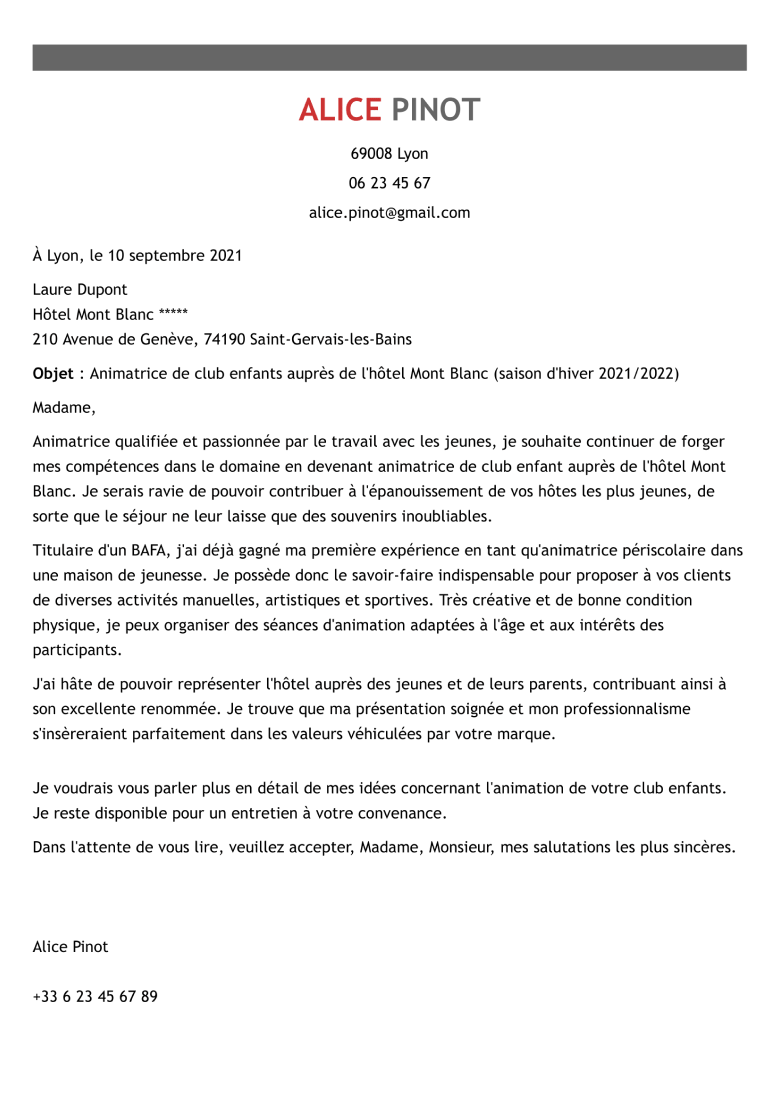
Adapting the letter to the profile and the position for a personalized application.
Writing a cover letter is not a mechanical process. To be convincing, it is essential to tailor its content to the position you are applying for and your individual characteristics. The specific nature of seasonal work requires a thoughtful approach where every word counts.
Start by clearly stating your availability. In a letter to a supermarket, for example, mentioning your ability to work Saturday afternoons or Sundays with extended hours can be a significant advantage. This type of information makes the recruiter’s job easier, as they know precisely when you could be available.
Next, discuss your academic background. If you are a recent high school graduate, indicate the program you will be starting in the fall, which will provide a timeframe for your availability. Students can draw on their academic background by mentioning acquired skills that could be relevant, even if they are not directly related to the position. This connection to your career goals demonstrates that you have thought about your future.
The skills presented in your cover letter should be a carefully curated selection. Include personal qualities such as dynamism and rigor, as well as skills relevant to the job you’re applying for. For example, a position in entertainment will greatly benefit from highlighting patience and interpersonal skills. These qualities are often supported by extracurricular or volunteer experiences, which also demonstrate your personal commitment. Specific motivation for the position is another key. Rather than using stock phrases like wanting to “earn some extra money,” explain what attracts you. If you’re applying to a hotel, talk about your desire to explore the tourism industry and improve your communication skills. This gives meaning to your application and reassures the employer of your commitment. To further prepare, you can also consult specialized advice on writing cover letters and resumes on job platforms, which can improve the quality of your application. For example, websites offering career guidance services are valuable resources. A clear structure and polished writing make for an impactful cover letter.
Organizing your cover letter according to a precise framework is essential to capture and hold the recruiter’s attention. A good letter follows a logical order that facilitates reading and gives meaning to your arguments. A letter for a seasonal job typically includes: A heading mentioning your contact information as well as that of the company, the date, and a clear subject line (example: “Application for the position of Multipurpose Employee – Ref. XYZ”).
A short introduction where you briefly introduce yourself, mention the desired position, and your exact availability.
The body of your letter should be divided into several paragraphs, providing details about your current or future studies, your specific motivations, relevant skills, and what you hope to contribute to the company. A conclusion should request an interview and thank the recruiter for their consideration of your application.
Each section should serve a specific purpose and follow a logical progression, avoiding any ambiguity or information overload. Clarity is essential in the opening sentence so the recruiter immediately understands what you are offering. Then, elaborate on your qualifications without exaggerating, always keeping them relevant to the job requirements. Proofreading is an often-neglected but potentially fatal step. A cover letter riddled with errors or inaccuracies seriously undermines your chances. Therefore, use online tools or have someone else review your text for an external perspective. Consulting examples available on Jobseeker or watching video tutorials, such as this one, can greatly help you master the form and content of your letter, ensuring a professional and tailored presentation. Illustrate your letter with a concrete example to make it more persuasive.
- Using a sample cover letter for a seasonal job can help guide your writing and allow you to envision a realistic scenario. Here’s an example summarizing best practices: Coraline Laurentin, a recent high school graduate from Tours, is applying for a housekeeping position at a hotel for the summer.
- She begins with a concise presentation of her profile and specifies her availability (from July 1st to August 30th, every day). She then mentions her volunteer experience in Tours, which strengthened her organizational skills and her ability to work in a team—skills transferable to the position she’s applying for.
- Her motivation is clear: to gain initial training in a profession and actively contribute to the quality of service at the hotel. Finally, she concludes by politely requesting an interview. This example provides a structure to follow and highlights the importance of a personalized letter.
This could easily be adapted to different sectors: sales, catering, entertainment. It also demonstrates that seasonal work can be considered a first step in a broader career path, thus lending weight to your application.
Avoid common mistakes and apply tips for an effective letter
Despite the effort invested, certain missteps can jeopardize an application. It is essential to avoid some classic pitfalls when writing a cover letter for a summer job.
First, avoid clichés and vague phrases like “I am very motivated” without further details. A professional and personalized tone remains the best strategy for establishing credibility. Don’t neglect to specify the exact job title and any relevant reference number; this shows that you’re addressing the job posting directly, not just a mass of indistinct employers.
Keep it concise. A letter that exceeds one page or gets bogged down in unnecessary details risks losing the reader. Get straight to the point with impactful, clear, and concise content, avoiding repetition.
Failing to indicate your exact availability is another mistake. A seasonal recruiter needs to plan their schedule accordingly; vagueness can lead to rejection. Finally, presentation is crucial: pay attention to the layout, proofread and correct everything, including your contact information, to avoid any errors that could jeopardize a successful connection.
To complement this approach, you’ll find helpful resources online, including guides on [topic missing].
A negotiated termination agreement in the public sector, while a different topic, illustrates the rigorous administrative procedures to follow in a professional setting, thus instilling the discipline necessary for proper drafting. A well-crafted letter that adheres to these guidelines maximizes your chances and helps you stand out among the candidates selected for an interview, a crucial step towards landing your desired summer job.