


Essential Elements for a Cover Letter When Changing Careers
A cover letter plays a central role in a career change. It serves to build a bridge between your previous professional experience and the new field you wish to enter. To be convincing, the letter must clearly present your professional objectives while illustrating your adaptability and the relevance of your transferable skills.
To begin, the heading should include your full contact information, as well as the precise purpose of your application. Using a professional salutation is essential; “Dear Sir/Madam” remains the most common and respectful approach.
In the body of the letter, an effective introduction immediately captures the recruiter’s attention. Introduce yourself briefly, mentioning your professional background and, above all, your desire to change career paths. Explain how this career change is part of a well-considered plan and how it fulfills a deep-seated desire or a new passion.
Then, develop an argument highlighting the skills acquired in your past experiences from the perspective of their transferability. For example, the project management or interpersonal skills you’ve developed in a previous role could be major assets in the new position.
End your cover letter with a dynamic conclusion that demonstrates your enthusiasm for the position and your availability for an interview. This section is crucial because it invites the recruiter to consider a meeting to discuss your career change in more detail.
This precise structure shows that you have mastered the art of writing and that your approach is serious, which is essential for making a strong impression in this type of application.
How to showcase transferable skills in a cover letter for a career change?
The success of your cover letter largely depends on highlighting your transferable skills. These skills bridge your past experience to the requirements of the position you are applying for, demonstrating your ability to adapt to a new sector.
Transferable skills are not limited to technical know-how. Communication, time management, teamwork, and problem-solving skills also illustrate key interpersonal skills. These human qualities are often described as soft skills and are highly valued in virtually every field.
To identify these skills, it is essential to review your experiences: break down your previous tasks to identify the actions and qualities that could be useful in a different profession. For example, if you have experience in customer service, your listening skills and diplomacy will be just as valuable for a position in project management or human resources.
It is strongly advised to support each skill with concrete examples. Instead of simply listing “project management,” illustrate how you coordinated a team to meet a deadline or optimize a budget. These elements strengthen your credibility and make your application more attractive.
Also consider the skills acquired during your training, even if it didn’t lead to a formal qualification. This knowledge demonstrates your proactive approach and your willingness to acquire the necessary tools to successfully transition to a new career.
Your letter should therefore be structured around a coherent narrative where these transferable skills are the cornerstone. This narrative justifies your motivation and demonstrates your new suitability for the desired role, a crucial argument for recruiters.
Example of a convincing cover letter for a career change
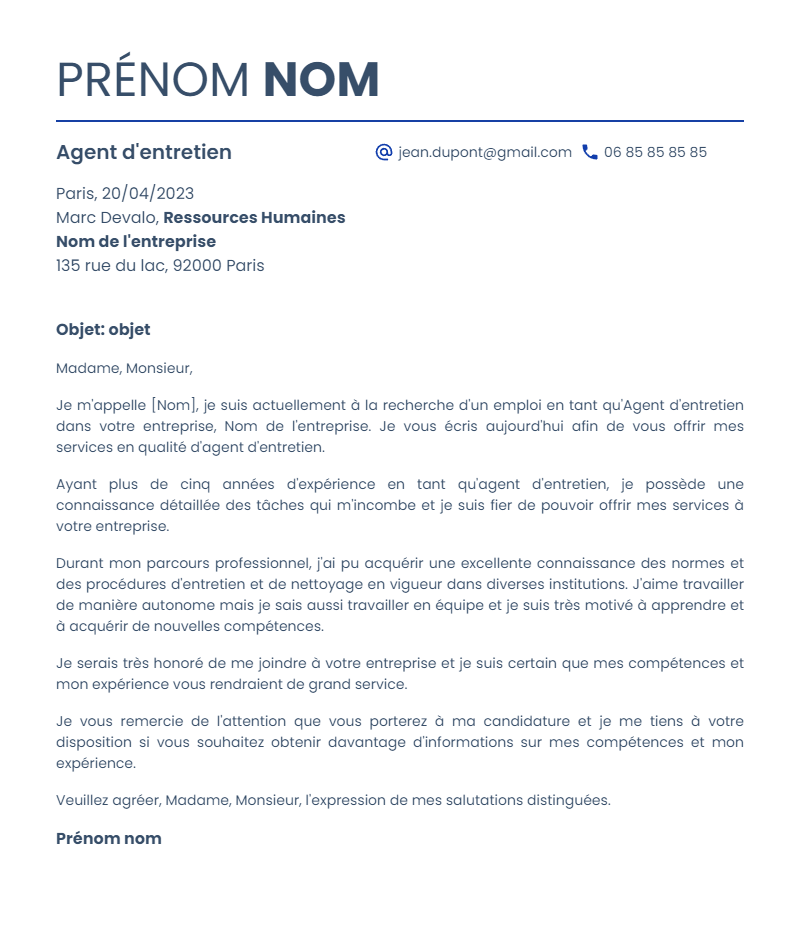
To better understand how to apply these tips, let’s analyze a sample cover letter adapted to a career change. Let’s imagine the case of Claire, a former communications officer who wants to become a digital project manager.
Claire begins her letter with a clear introduction: she mentions her years of experience in communications and her growing interest in new technologies. She specifies that this career change is a well-considered project, where she wants to combine her passion for digital with her management skills.
She then describes her transferable skills: organization, team coordination, and mastery of digital communication tools acquired through self-study. She illustrates her point by mentioning a project where she successfully led a multi-channel campaign. Finally, Claire expresses her sincere motivation to join the target company, having studied its values and the professional goals she shares with it. Her letter concludes with an invitation to an interview, ready to elaborate on how she can actively contribute to the team’s growth. This template stands out for its authenticity and clear structure, avoiding the pitfalls of an overly standardized letter or a simple resume summary. To create your own letter, draw inspiration from this approach, adapting the content to your profile and the target company.
To further develop your writing skills, you can consult dedicated articles and templates such as those offered on [website/platform name].
Specialized resources for writing cover letters
Mistakes to absolutely avoid when writing a cover letter for a career change
A cover letter is a powerful tool, but it must adhere to certain fundamentals to avoid harming your application. A common pitfall is the temptation to copy and paste. Each letter must be entirely personalized for the targeted position and company, otherwise it risks appearing impersonal.
Furthermore, it is important to use clear and concise language. Avoid long, convoluted sentences that lose the reader. The goal is to convey your message in an easy-to-read manner, highlighting your career change project and your key skills.Another trap is summarizing your resume in the letter. The letter should complement your application by telling your professional story, explaining your transition, and demonstrating your added value to the company.
To personalize your letter effectively, research the company’s values and projects. Subtly incorporate this information into your letter to demonstrate that your application is driven by a genuine professional interest.
If you’d like to learn how to optimize your application for a career change, you can consult reputable online guides, particularly those on
accessing personal online job portals
, which offer a wealth of valuable resources.
Finally, carefully reread your letter several times and have someone else proofread it to avoid spelling mistakes or awkward phrasing that could damage your professional image. Effectively prepare for your career change before writing your cover letter.
Writing a cover letter for a career change is just one step in what is often a long and complex process. To succeed, it’s essential to have clearly defined your reasons and professional goals beforehand. Understanding why you want to change careers will help you express this motivation clearly in your letter. A skills assessment is a valuable resource at this stage. It allows you to precisely identify the skills and knowledge you can transfer to a new job. For example, if you’ve moved from an industrial sector to a more creative field, you can highlight your rigor and organizational skills as key assets. Training before applying is also a sign of seriousness and commitment. Whether through short courses, MOOCs, or internships, these skills enhance your expertise in the new field. They should be mentioned and emphasized in your cover letter to demonstrate your willingness to invest in the process.