
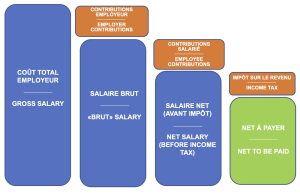

Understanding the Fundamentals of Gross and Net Salary in 2025
Calculating gross salary from net salary is essential for any employee wishing to better manage their compensation and personal finances. In 2025, the mechanism remains based on social and tax laws that are constantly evolving, requiring a grasp of key definitions such as base salary, gross salary, and net salary.
Base salary corresponds to the compensation negotiated in the employment contract, generally set for full-time work based on 35 hours per week, which equates to 151.67 hours per month. This base salary may vary according to the specific terms of the contract and collective bargaining agreements, and must never be less than the gross minimum wage (SMIC) or the applicable collective bargaining agreement minimum. It is crucial to understand that base salary does not include bonuses, overtime, or benefits in kind, which are added to the gross salary.
Gross salary encompasses more than just the base salary; it includes overtime pay, various bonuses (seniority, 13th-month bonus, performance-based bonuses), and benefits in kind such as a company car or housing. This gross amount is the one shown on the payslip before social security contributions are deducted.
Furthermore, net salary represents what the employee actually receives before income tax is deducted, that is, after all mandatory social security contributions and other levies, such as the CSG and CRDS, have been deducted. This amount, shown on the payslip as “net pay,” is the amount available in the employee’s bank account, excluding income tax withheld at source since 2019. The distinction between net pay and net taxable income is also fundamental. Net taxable income takes into account contributions that are not deductible from taxable income, such as the non-deductible portion of the CSG (General Social Contribution), the CRDS (Contribution to the Repayment of the Social Debt), and the employer’s contribution to supplementary health insurance. Understanding this nuance allows you to anticipate the tax impact on your actual compensation. In practice, this knowledge facilitates the use of tools such as a salary simulator

and HR managers who need to prepare accurate and compliant payslips.
Discover how to easily convert your gross salary to net, understand the differences between these two amounts, and calculate what you will actually receive each month in France. The mechanisms of withholding tax and its impact on net salary
Since the introduction of withholding tax (PAS) in 2019, the net salary received by the employee takes into account the immediate deduction of income tax from the monthly salary. This change has transformed how payslips are read by clearly separating the
net pay before income tax
from the amount actually paid after deductions.
The calculation of these deductions is based on the net taxable salary, meaning that social security contributions are deducted first, followed by income tax calculated according to a rate provided by the tax authorities. This procedure allows for a personalized adjustment of the tax burden, depending on each taxpayer’s income and family situation, thus reinforcing the principle of progressivity. The tax rate applied can vary considerably between two people within the same company, as it is personalized according to the tax household. Employees also have the option of choosing an individualized rate or a neutral rate if, for example, they do not wish to share their personalized rate with their employer. This choice directly impacts the amount shown on the payslip.
For example, let’s consider a hypothetical employee who receives a net taxable salary of €2,000. If the applicable neutral rate is 2.90%, the income tax withheld at source will be €58. This amount is deducted from the net pay before tax, thus reducing the amount actually received each month.
This distinction and mechanism are essential for sound payroll management advice, whether in payroll departments or through the use of integrated human resources software. A high-performance tool incorporates this simulation functionality and facilitates understanding during annual salary reviews. Finally, it should be noted that the rate is recalculated annually based on the most recent tax return and generally applies from September to August. This periodicity allows for continuous adjustments based on changes in the employee’s personal and professional circumstances.
Detailed breakdown of social security contributions in 2025 and their impact on net salary
The transition from gross salary to net salary involves the deduction of social security contributions that finance social protection: health insurance, retirement, unemployment benefits, social security contributions, etc. These mandatory charges are central to the calculation of net salary and can represent, on average, a deduction of approximately 31% of gross salary in the private sector. For non-managerial employees, contributions include, in particular, the old-age pension contribution capped at 6.9% of gross salary within the monthly Social Security ceiling, the uncapped old-age pension contribution of 0.4%, as well as contributions dedicated to the Agirc-Arrco supplementary pension scheme. Social security contributions such as the CSG and CRDS also apply, with an overall rate of over 9%, a portion of which is tax-deductible. For managers, contributions are generally similar but also include a specific contribution to APEC, facilitating the transition to management positions. Since 2019, the merger of Agirc and Arrco has simplified the rules, while adapting contributions to two distinct brackets based on income level. This complexity largely justifies the use of a gross-to-net salary calculator or high-performance human resources software to ensure the accuracy of payslips. An employee earning €2,500 gross could see a total deduction of around €521 in social security contributions, while an executive with a gross salary of €5,000 would have over €1,000 deducted from their gross pay. This data highlights the importance of accurate timekeeping and precise management by the payroll department, particularly for monitoring overtime and bonuses, which impact the final gross pay. The complexity of social security contributions also reinforces the need for high-quality payroll management advice to avoid errors, especially in companies where collective bargaining agreements add specific charges or benefits in kind. A thorough understanding of these elements is essential for effectively negotiating compensation and grasping the real impact of variations in gross salary on net pay.
Simulating Your Net Salary from Gross Salary with Online Tools in 2025
Faced with this ongoing complexity, it has become essential for employees and HR managers to have access to reliable tools that allow them to estimate their net pay from their gross salary. Using an online salary simulator facilitates understanding and financial planning, while providing transparency regarding the composition of the payslip.
A good simulator not only calculates social security contributions but also includes income tax withholding, allowing for an accurate estimate of the actual net salary paid. These simulators are invaluable for building a career plan, negotiating a raise, or simply better anticipating monthly income.
For example, an employee earning the minimum wage in 2025 can quickly convert their gross hourly wage to net using a multiplier, making it easier to compare with other job offers or assess the impact of increased hours.
Companies, for their part, have tools integrated into their human resources software that automate the creation of payslips, calculate deductions, and prepare social security and tax declarations. This reduces the risk of errors and improves compliance with legal obligations.
With the development of online services and mobile applications, employees can now access their digital payslips, view details of social security contributions, and even perform personalized simulations directly from their phones. This digital progress is boosting the payroll sector while offering employees greater transparency and control.
Regular use of these tools also contributes to developing expertise in compensation matters, a major advantage for all employees wishing to optimize their financial and tax situation. A thorough reading of the payslip: deciphering each line to master your salary The payslip is the official document that summarizes an employee’s compensation. For an employee in 2025, it is crucial to know how to read this document beyond simply stating the net pay.
Each section of the payslip provides precise information: base salary, overtime, various bonuses, employee contributions broken down by type (old age, unemployment, health, supplementary pension), the CSG-CRDS (General Social Contribution and Social Debt Repayment Contribution), as well as the amount of withholding tax applied to taxable income.
For example, an employee noticing an unexpected increase in their health insurance or supplementary health insurance contributions can contact the payroll department or a compensation management expert to clarify the situation or adjust their settings. Similarly, employees should verify that all elements stipulated in their employment contract, such as bonuses or benefits in kind, are correctly included on their payslip.
The payslip is also the tool for identifying potential errors, such as an incorrect withholding tax rate or unrecorded overtime. In such cases, communication with the human resources department is essential to rectify the mistakes. A better understanding of one’s payslip also means understanding how each gross euro is allocated between social security contributions, taxes, and net salary. This in-depth knowledge fosters constructive dialogue with the employer, particularly during salary negotiations or the annual review.
For payroll professionals
Training employees to read their payslips and providing them with access to a personalized salary simulator is a recommended practice to boost satisfaction and transparency within companies.
Discover how to manage your personal finances with a good gross-to-net calculator to better prepare for your annual reviews.