


The INPI One-Stop Shop: A Simplified INPI Platform to Centralize All Your INPI Business Procedures
The INPI One-Stop Shop revolutionizes business administration by offering a centralized INPI business interface. Imagine Léa, a young entrepreneur who dreamed of launching her innovative startup. Before the One-Stop Shop, she had to juggle multiple contacts and fill out numerous forms scattered between the commercial court registry, the INSEE (National Institute of Statistics and Economic Studies), and the URSSAF (French social security agency). This fragmentation could quickly become a hindrance, leading to errors or sometimes costly delays. Thanks to the integrated INPI service, Léa now has access to a single INPI business portal, which consolidates all the formalities for business creation, modification, cessation of activity, and filing of annual accounts. This INPI One-Stop Shop solution allows you to complete all your INPI business procedures from a single, secure entry point.
This centralization is part of a comprehensive INPI simplification initiative aimed at reducing the administrative burden for entrepreneurs. Each form on the one-stop shop is designed to automatically adapt to the specific details of the submitted application, making the user experience pleasant and intuitive. When Léa enters information about her future business, such as its company name, legal structure, and APE code, the portal automatically transmits the data to the relevant organizations, including the commercial court registry and INSEE (the French National Institute of Statistics and Economic Studies). This frees her from numerous repetitive tasks, allowing her to focus on the core of her project.
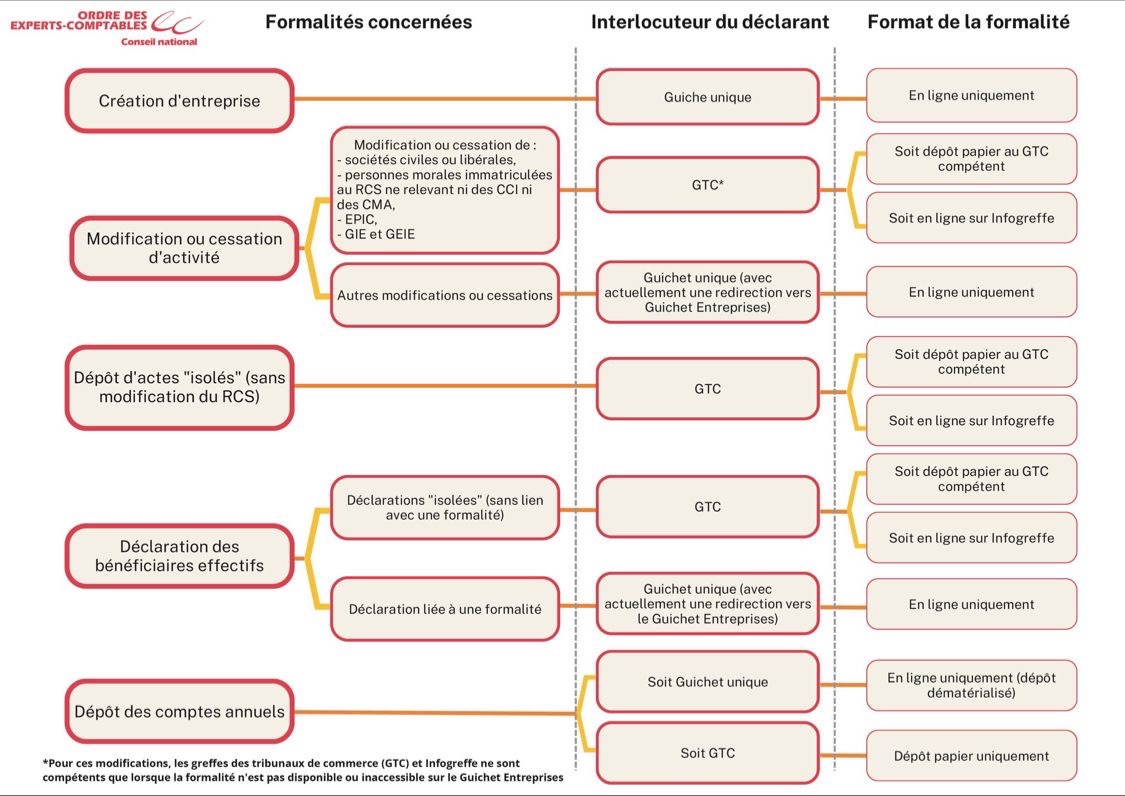
Discover the INPI single point of contact to simplify all your business procedures in one place, quickly and efficiently.
How the INPI Single Point of Contact Works: Simplify your INPI business procedures from A to Z
The administrative landscape of French businesses has long been perceived as a labyrinth, with multiple contacts and inconsistent procedures. The INPI single point of contact acts as a seamless and consistent interface for businesses, standardizing access to formalities. It operates through a single portal accessible at procedures.inpi.fr, allowing any entrepreneur to complete their procedures online.
To get started, the prospective user simply needs to create an account using an email address or via secure login with FranceConnect, a single access system for several public services. The dynamic form then adapts based on the information provided. For example, a sole trader creating a micro-enterprise will use a different form than someone wishing to amend the articles of association of their limited liability company (SARL).
This adaptability aims to ensure that only relevant information is requested, thus reducing the margin of error. Once the application is complete, its progress can be tracked in real time, with notifications sent in case of any issues. Electronic signatures are seamlessly integrated into the process, eliminating unnecessary paperwork. The simplified INPI platform thus becomes a true ally, often transforming what was once a chore into a quick and straightforward task.
For example, in the case of amendments to the company’s articles of association, the platform guides the user step by step to register the new share distribution, updated contact information, and the registered office address. Each step is clearly explained, reducing the risk of rejection by the registry. The applications are then automatically transmitted to the relevant authorities, offering significant time savings for entrepreneurs.
This modernization of the entrepreneurial experience through an integrated INPI service aims to simplify the process, whether for routine tasks like filing annual accounts or more complex operations such as business closures. Despite this apparent simplicity, it is essential not to overlook certain technical requirements to avoid rejections, which we will discuss in the following section.
Common errors on the INPI business portal and how to avoid them for successful INPI simplification
Although the INPI’s single point of contact is designed to streamline the process, some pitfalls remain and can make the experience tedious. Among the recurring errors, incomplete applications remain the primary cause of delays. For example, a missing proof of address or a document not electronically signed can lead to an outright rejection. This is what happened to Marc, a craftsman whose business creation application was blocked for several weeks simply because he had forgotten to include proof of address.
In addition to missing documents, anomalies related to the data entered are common. Some entrepreneurs fail to fill in all the required fields or enter inconsistent information, such as a company name different from the one registered in the articles of association. Furthermore, the format of uploaded files is not always compliant with the recommendations, which can result in the automatic blocking of the procedure. Some users have reported that despite a compliant PDF, the system rejected the file, revealing a particular sensitivity in the IT system. To overcome these difficulties, it is recommended to adopt a proactive approach by taking the time to carefully review and verify each document before submission. It is also helpful to regularly consult the guides and FAQs available on the INPI’s simplified platform. These resources explain, for example, which digital formats are accepted, or the exact nature of the supporting documents required depending on the type of INPI procedure undertaken.
Furthermore, some entrepreneurs prefer to rely on professional support to ensure the success of their applications. These professionals include chartered accountants, lawyers, and notaries who are fully versed in the workings of the single portal. Such support often proves crucial in avoiding the frustration of rejected applications and allowing for a smooth transition into the administrative management of the business. Thus, relying on an integrated INPI advisory service can transform a potentially difficult experience into a success.
It is also worth noting that to guarantee the availability and maximum security of the single portal, alternative solutions such as Infogreffe or paper filing are temporarily available. These options will remain in place until the end of 2024 to allow businesses to adapt smoothly to changes in the system.
Governance and evolution of the INPI single portal: towards an ever more efficient INPI business interface
The success of the INPI single portal is based not only on effective technology but also on rigorous governance that involves all stakeholders. Since the summer of 2023, a strategic committee has brought together partner ministries, the INPI (National Institute of Industrial Property), INSEE (National Institute of Statistics and Economic Studies), commercial court registries, and social security organizations such as URSSAF (Union for the Collection of Social Security and Family Allowance Contributions) and tax authorities, including the DGFIP (Directorate General of Public Finances). This collaboration aims to maintain consistency and seamless communication between the various institutions involved in INPI filing procedures.
This steering committee works closely with a user committee, which includes representatives of businesses and their agents. This committee is essential for gathering feedback, identifying any malfunctions, and guiding future developments of the simplified INPI platform, taking into account the specific needs on the ground.
Since the official launch of the single portal, these bodies have met regularly to ensure the continuous improvement of the INPI integrated service. This structure guarantees responsiveness to problems, particularly regarding usability and managing the occasional peaks in activity experienced by the platform. This participatory approach is a major asset for ensuring the long-term viability of the INPI portal solution and effectively meeting user expectations.
More than 4 million formalities have already been filed on the platform since January 1, 2024, including 1.4 million incorporations, 900,000 modifications, 500,000 cessations, and 800,000 filings of annual accounts. These figures demonstrate the widespread adoption by the French business community and the relevance of the single portal to the day-to-day operations of companies.